Renault Group and Its Brands Recorded Growth for the Third Consecutive Year
Driven by international sales performance and an electrification-focused product strategy, Renault Group recorded growth for the third consecutive year in 2025, reaching global sales of 2,336,807 units, representing an increase of 3.2%. Ranking among the leading automotive manufacturers in Europe based on its passenger car performance, the Group achieved approximately 400,000 hybrid vehicle sales, marking a 35.1% increase, while electric vehicle sales rose by 76.7% to around 194,000 units.
The above-market performance across all Renault Group brands clearly demonstrated the tangible results of the Group’s balanced commercial policy and electrification strategy.
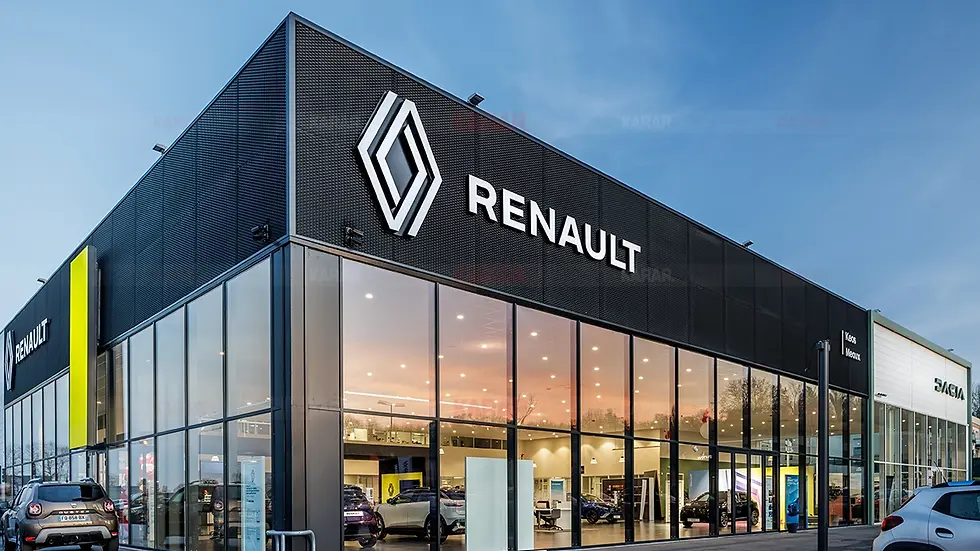
In 2025, Renault Group sold a total of 2,336,807 vehicles worldwide. In a market that grew by 1.6%, the Group achieved a 3.2% increase, delivering above-market growth across all three of its complementary brands.
Renault recorded 1,628,030 vehicle sales, representing a 3.2% increase compared to 2024.
Dacia achieved 697,408 vehicle sales, marking a 3.1% rise year on year.
Alpine surpassed the 10,000-unit threshold for the first time, reaching 10,970 vehicle sales and delivering strong growth of 139.2%, more than doubling its sales compared to the previous year.
In Europe, Renault Group reached sales of 1,607,848 units, ranking among the leading automotive manufacturers, supported in particular by its strong passenger car performance in the C segment.
Renault Group’s passenger car (PC) sales increased by 5.9%, delivering more than double the market growth rate of 2.3%. With this result, the Group became the number one automotive group in France.
Renault Group’s light commercial vehicle (LCV) sales showed signs of a gradual recovery in 2025. After declining by 29.6% in the first half of the year, the decrease eased to 10.6% in the second half, indicating an improving trend.
In international markets, the Renault brand increased its sales by 11.7%, driven by strong growth in its core markets. This performance was supported by increases of 11.3% in Latin America, 55.9% in South Korea, and 44.8% in Morocco.
The Group continues to pursue a value-driven and disciplined commercial policy:
Renault Group maintains a strong position in the retail customer segment across its five key European markets. In these countries, retail sales account for around 60% of the Group’s passenger car sales, delivering a performance 16.9 percentage points above the market average. In addition, three models rank within the top five in this category.
In Europe, sales of C-segment and higher models represent 31.1% of the Group’s total passenger car sales. This figure marks a 1-point increase compared to the previous period, highlighting the strengthening focus on higher segments within the product mix.
Compared with its European competitors, the Group continues to demonstrate a meticulous and disciplined approach, achieving residual values that are 5 to 12 points higher.
Renault Group is continuing its passenger car (PC) electrification drive in Europe, achieving sales of around 400,000 hybrid vehicles, representing 35.1% growth. Electric vehicle sales reached approximately 194,000 units, reflecting a 76.7% increase.
With the contribution of new models, Renault strengthened its leadership in electric vehicles, increasing its EV mix to 20.2%, while also maintaining a strong focus on hybrid (HEV) sales, delivering 17.0% growth in this segment.
Dacia, meanwhile, sold over 113,000 hybrid vehicles throughout the year, representing a very strong increase of 121.7% compared to 2024.
The Group will continue its product offensive in 2026:
To renew and expand its internal combustion and electric product range in Europe, Renault Group plans to launch the new Renault Clio, Renault Twingo E-Tech Electric, a new A-segment electric Dacia, a new C-segment internal combustion and hybrid Dacia, as well as the Alpine A390.
At the same time, the Group is accelerating its international expansion. Within this scope, Renault plans to introduce the Renault Boreal for Latin America and Türkiye, the Renault Duster for India, the Renault Filante for South Korea and overseas markets, as well as a new Renault pick-up model for the Latin American market.
Renault Group Chief Growth Officer Fabrice Cambolive commented on the results as follows:
“The Group’s commercial results clearly reflect the strong alignment between our value-driven product plan, disciplined commercial policy, and consistent strategy. This year, our performance in international markets complements our growth in Europe. The complementarity between our brands and technologies is one of the key strengths that enables us to respond to customers’ evolving needs.
Our dual powertrain strategy is now fully deployed across the Group. With two-thirds of its sales coming from electric and hybrid vehicles, Renault stands as the best-performing generalist brand in its segment in terms of CO₂ emissions. Dacia, meanwhile, is accelerating its growth in the hybrid segment.
Behind our ability to sustain strong commercial performance while advancing electrification lie two true game changers: our hybrid technologies, which meet both customer expectations and CO₂ regulatory targets simultaneously, and our 100% electric platforms, which enhance product appeal and strengthen sales performance.”
Renault Brand – Growth for the Third Consecutive Year
In 2025, Renault delivered a strong performance, selling 1,628,030 vehicles worldwide and achieving 3.2% growth. This result was driven primarily by 10.0% growth in the global passenger car market.
In Europe, the brand rose to second place in combined passenger car (PC) and light commercial vehicle (LCV) sales. This success was largely supported by a 7.4% increase in passenger car sales. Renault’s strong passenger car performance is underpinned by the brand’s dual electrification strategy. On the one hand, full hybrid sales increased by 17.0% to approximately 287,000 units, accounting for 38.4% of Renault’s total passenger car sales. This share stands 25.6 percentage points above the market average. Renault maintained its position as the second-largest brand in the European hybrid market, with the Symbioz positioned as the best-selling hybrid model in its lineup.
On the other hand, electric vehicle sales rose by 72.2% to 151,939 units. Supported by the success of the Renault 5 E-Tech Electric, the second best-selling electric model in the European retail passenger car market, electric vehicles now account for 20.2% of Renault’s total passenger car sales.
In the light commercial vehicle segment, Renault’s sales declined by 21.1% to 244,927 units, impacted by an 8.3% contraction in the total European market volume (TIV), the withdrawal of the Express model, and the gradual rollout of the new Master model family. Despite this, a gradual recovery was observed during 2025, with the decline easing from 29.2% in the first half of the year to 11.1% in the second half.
Outside Europe, Renault’s combined passenger car and light commercial vehicle sales increased by 11.7%, raising the share of these markets in total sales to 38% (+2.9 points). Driven by strong growth of 11.3% in Latin America, 55.9% in South Korea, and 44.8% in Morocco, Renault maintained its position as the best-selling French automotive brand worldwide.
Continuing its value-driven commercial strategy, Renault increased its retail market share in many European countries. Residual values remained stable globally in 2025 and continued to stand 5 points above the market average, representing a total improvement of 7 points since 2021.
The Renault brand will continue to build on its strong foundations in 2026:
In Europe, the rollout of Renault 4 E-Tech into new markets and the commercial launch of Twingo E-Tech will sustain the brand’s electrification momentum, while the market introduction of the new Clio will continue.
Outside Europe, the International Game Plan will move forward at full speed, with the expansion of Boreal into new markets, the launch of Filante in South Korea, the Gulf countries, and Colombia, the introduction of Renault Duster in India, and three new products to be launched by 2027.
Momentum in light commercial vehicle sales will be supported by a broader Master model family.
Dacia Brand – Europe’s Second-Largest Brand in the Retail Customer Segment
In Europe, Dacia achieved sales of 601,765 units, delivering 2.9% growth. With its strong focus on the retail sales channel, the brand reached a 7.9% market share in the European retail passenger car market, securing second place on the podium in this channel.
These results were supported by the brand’s five core models. Notably, Sandero became Europe’s best-selling passenger car across all sales channels. Launched in the second quarter of 2025, Bigster emerged as the best-selling C-SUV among retail customers in Europe in the second half of 2025. The Spring model also achieved a milestone by becoming the best-selling A-segment electric vehicle across all channels for the first time.
In 2025, Dacia continued the electrification of its product range. Supported by the Duster and Bigster, hybrid vehicle sales more than doubled, recording 121.7% growth and accounting for 19.2% of total passenger car sales (+10.3 points). One out of every four Dacia vehicles sold is now electric or hybrid, a ratio that has doubled compared to 2024.
In 2026, the brand will continue to develop its lineup with a strong focus on electrification, launching a new A-segment electric model and adding a new C-segment internal combustion and hybrid model to its range.
Alpine Brand – Triple-Digit Growth
In 2025, Alpine delivered one of the strongest performances in its history in the premium automotive segment, reaching 10,970 registrations and achieving triple-digit growth of 139.2%. Surpassing the 10,000-unit threshold for the first time marked a major milestone for the brand. This momentum was driven by strong performance in key European markets, including France (+89.5%), the United Kingdom (+369.5%), Germany (+133.5%), Spain (+584.4%), and Italy (+216.4%).
The Alpine A110 continued its leadership in the two-seater sports coupé segment with 2,681 units sold, while the successful launch of the fully electric A290 played a decisive role in the brand’s growth, reaching 8,198 units sold. Introduced at the end of 2025, the Alpine A390 is positioned as the new model of Alpine’s “Dream Garage” vision and the brand’s first sporty fastback. The A390 represents a key step in supporting Alpine’s growth by attracting new customer segments.
Alpine’s international presence also continued to expand. With the addition of 15 new sales points, the brand now operates 169 stores and workshops across 25 countries, with further expansion planned for 2026.
Built on its motorsport heritage, strong engineering expertise, and an innovation-driven product strategy, Alpine has strengthened its position as a key player in the premium sports car market, while also laying a solid foundation for future growth and electrification.

Comments